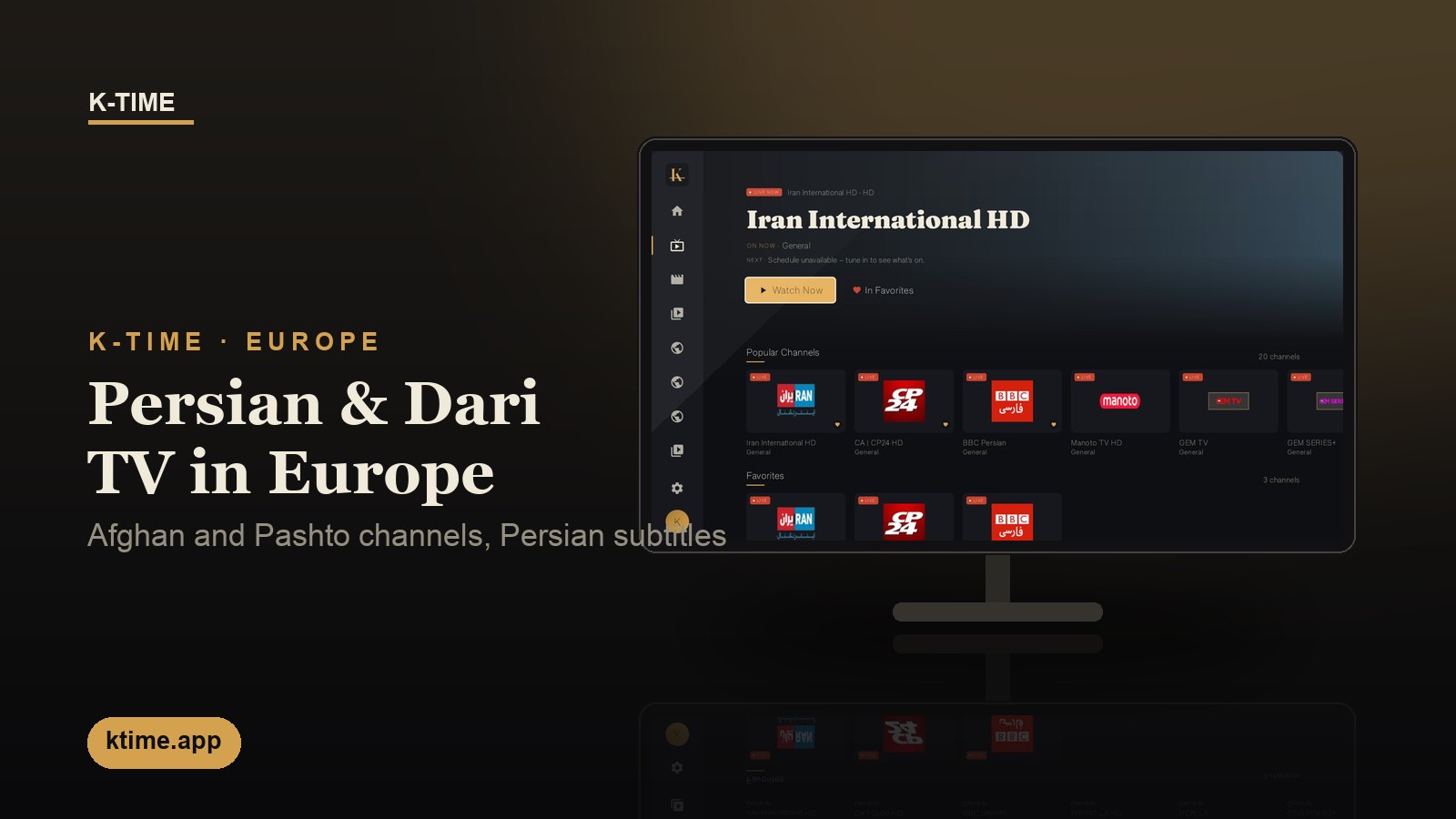
If your household speaks Dari or Pashto and you live in Hamburg, Stockholm, Paris, Vienna or Amsterdam, the practical answer is that K-Time already carries the channels you would look for. Fifteen Afghan and Pashto-language live channels stream in the grid as of 2 September 2026 — Tolo TV, TOLOnews, Amu TV, Afghanistan International, Lemar TV among them — beside 300+ Persian-language channels and a catalog of 24,000+ films and series. Nothing here needs a VPN, and any European card pays for it.
This is the Afghan-audience edition of our guide to watching Persian TV outside Iran. We will be direct about where the service is strong for a Dari-speaking family and where it is thin, because a guide that oversells is useless to the person reading it.
| Afghan and Pashto-language live channels | 15 (as of 2 September 2026) |
| Persian-language live channels | 300+ (302 live) |
| International titles with Persian subtitles | 11,500+ |
| International titles with a Persian dub | 7,200+ |
| Afghan films and co-productions in the catalog | 10 |
| Price | CA$9.99/month · CA$54.99/6 months · CA$99.99/year |
| No card? | 36 USDT for 12 months via Telegram @KtimeSaleBot |
| VPN needed | No — no geo-block anywhere in Europe |
Which Afghan TV channels can I watch online in Europe?
Fifteen Afghan and Pashto-language channels are live on K-Time as of 2 September 2026. Fourteen of them carry news, general programming, music and entertainment; the fifteenth carries religious programming and is in the grid as well.
| Channel | Category | Language |
|---|---|---|
| Tolo TV | General / entertainment | Dari |
| TOLOnews | News | Dari |
| Amu TV | News | Dari |
| Afghanistan International | News | Dari |
| Tamadon TV | General | Dari |
| Sohail TV | General | Dari |
| Watan-e-Maa TV | General | Dari |
| Dunya Naw TV | General | Dari |
| ABN Afghanistan | General | Dari |
| 4 Afghanistan | General | Dari |
| Kayhan TV | Music | Dari |
| Lemar TV | Entertainment | Pashto |
| Pashto 1 | Entertainment | Pashto |
| BBC News Pashto | News | Pashto |
These sit in the same grid as the Persian-language lineup, so one remote reaches both. Channel lineups from third-party broadcasters do change over time; the table above is what was live on the date named, and our Persian live TV guide tracks the current state of the grid.
Can Dari speakers follow Persian subtitles and Persian channels?
Yes — and this is the part that makes the whole catalog useful rather than just the fifteen channels. Dari and Iranian Persian are two standard varieties of the same language, written in the same script, and a reader of one reads the other without training. A Persian subtitle track is therefore a Dari subtitle track in practice, and Persian-language news or drama is followable even where a handful of everyday words differ.
What that unlocks on K-Time is 11,500+ international films and series carrying a Persian subtitle track and 7,200+ carrying a Persian dub — Turkish, Korean, European and American titles, not just Iranian ones. For a household where the parents read Persian and the children have grown up with German, Swedish or French, that is usually the row everybody can agree on. Turkish drama in particular has a long Persian-speaking audience, and 316 of the 384 Turkish series on K-Time have Persian subtitles; our Turkish series with Persian subtitles guide is the map to that shelf.
Are there Afghan films on K-Time?
Ten. That is the honest number, and it is small — K-Time is a Persian-cinema library that happens to serve an Afghan audience well through its channels and subtitles, not an Afghan film archive. What is there is worth knowing about.
Osama (2003, 83 minutes), directed by Siddiq Barmak and shot in Dari, won the Golden Globe for Best Foreign Language Film. The Kite Runner (2007), directed by Marc Forster from Khaled Hosseini’s 2003 novel, plays largely in Dari. The Patience Stone (2012, 102 minutes) is Atiq Rahimi’s Dari-language adaptation of his own Goncourt-winning novel, and was Afghanistan’s submission to the 85th Academy Awards. And Three Songs for Benazir (2021, 22 minutes), directed by Elizabeth Mirzaei and Gulistan Mirzaei in Dari and Pashto, was nominated for the Academy Award for Best Documentary Short at the 94th Academy Awards.
The remaining six are Iranian–Afghan co-productions and documentaries. If you want the second generation watching along, the Iranian films with English subtitles collection is the shelf built for exactly that, and you can browse every film and series directly.
Where in Europe does this matter most?
Germany has by a wide margin the largest Afghan community in Europe — 442,020 people, per the Afghan diaspora figures for 2024 — with Hamburg alone counting around 51,000, more than any other German city. France follows at about 124,830 (2023), then the United Kingdom at 93,296 (2023), Sweden at 67,858 (2023), the Netherlands at 51,830 (2021), Austria at 44,918 (2023), Denmark at 21,635 (2024) and Norway at 19,072 (2023). Across those eight countries alone that is roughly 865,000 people.
None of it changes how the service behaves — the same subscription works identically in every one of them — but it does explain why “Dari TV online” and “Afghan channels live” are searched in German, French and Swedish as often as in Persian. If Germany is where you are, the Germany country guide covers the local specifics: euro pricing, German cards, and which devices are easy to buy there.
Which devices work, and what do I need to install?
Whatever you already own is almost certainly enough.
A browser is the whole setup. ktime.app/app plays films, series and live TV in Chrome, Safari, Edge and Firefox on a phone, tablet or computer, with nothing to install — iPhone and iPad included, through Safari. Our browser guide is the two-minute version.
On the television, the K-Time app installs on Android TV, Google TV, Fire TV and Nvidia Shield from ktime.app/k. A Fire TV Stick in an HDMI port turns any television into one of those for around €60. The device-by-device setup guide walks through each.
On a Samsung or LG smart TV, there is no native app; you install the free Media Station X app from the TV’s own store and type a personal {code}.ktime.app address once, after which it opens straight into the K-Time portal. The screen-by-screen version is in the all-device how-to-watch guide.
On an Android phone or tablet, there is a native app. There is no native iPhone app, no Apple TV app and no AirPlay — on Apple hardware you watch in Safari instead.
What does it cost, and what if I have no card?
The plans are CA$9.99 a month, CA$54.99 for six months, or CA$99.99 for a year, billed in Canadian dollars and converted by your own bank — roughly €6.20, €34 and €62 at the 2 September 2026 rate. Any European Visa, Mastercard or Amex works. One subscription plays one device at a time.
If you have no card that reaches the processor, there is a second rail: 36 USDT for 12 months, arranged through the Telegram bot @KtimeSaleBot, which verifies the transfer on-chain and creates the account automatically, usually inside a minute. It is a 12-month plan only — a crypto transfer has no recurring-billing mechanism, so there is no monthly version of it. No VPN is involved on either rail.
Watching on K-Time
Sign up at ktime.app/app/signup and you can start watching in that same browser window; for the living room, install the app from ktime.app/k on an Android TV, Google TV or Fire TV. You land on 15 Afghan and Pashto-language channels, 300+ Persian-language channels, and 24,000+ films and series with Persian subtitles or dubs — one device at a time, no VPN, any European card.
The Persian edition of this guide covers the same ground for readers of the Persian script, and the Germany guide goes deeper on euro pricing and German devices.