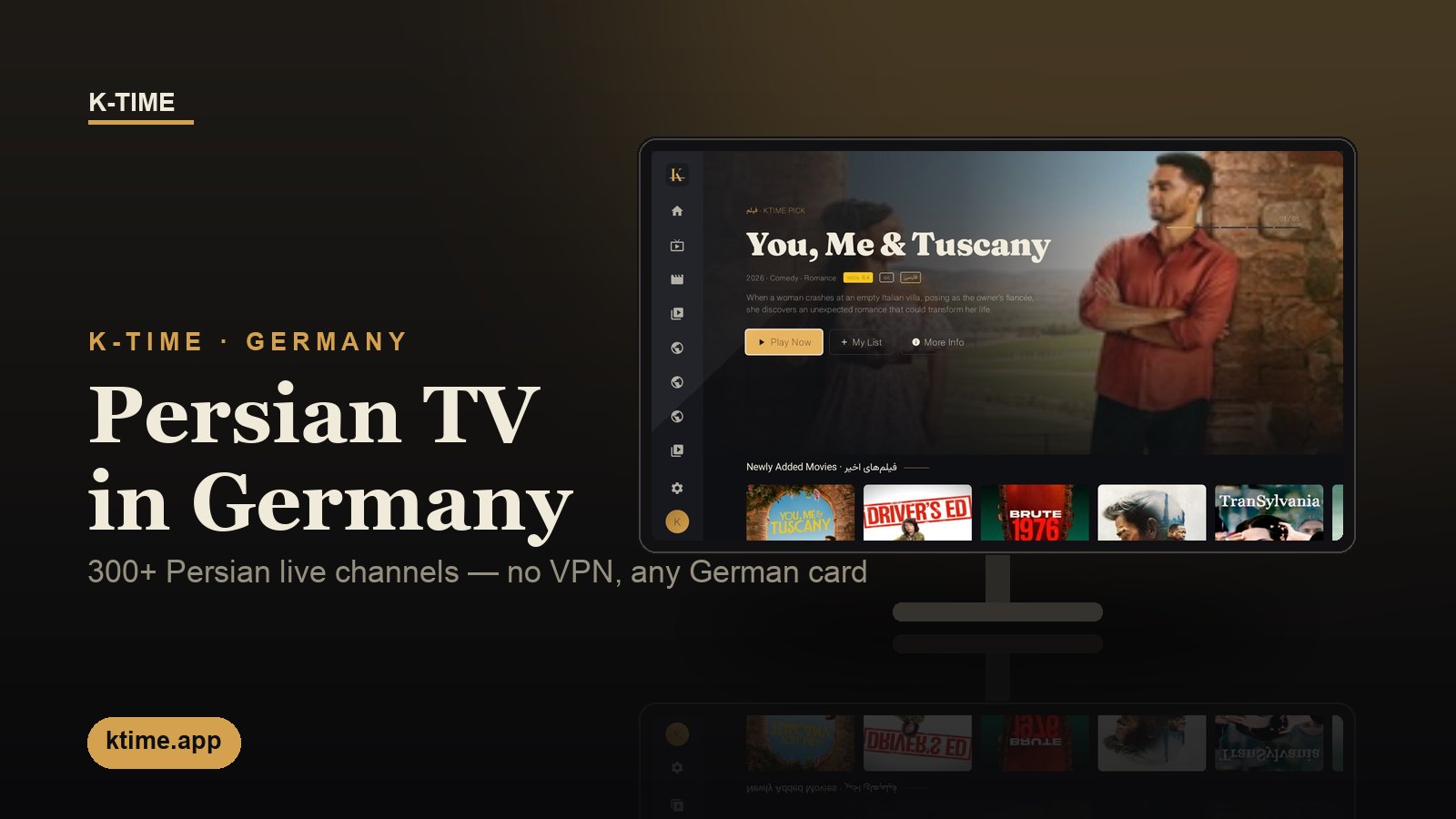
If you live in Berlin, Hamburg, Frankfurt, Munich or Cologne and want Persian television at home, the answer is short: K-Time opens in Germany with no VPN, takes a German bank card, and puts 300+ Persian-language live channels and 24,000+ films and series on whatever screen you already own. There is no German app store to wait for and no region setting to change. You sign up in a browser at ktime.app/app and the first channel is playing a couple of minutes later.
Germany is the largest Iranian community in Europe — about 319,000 people of Iranian background, according to figures the Federal Statistical Office reports for 2024 — and it has been the least-served by Persian streaming, because most guides on this subject are written for North America. This is the German edition of our wider guide to watching Persian TV outside Iran.
| People of Iranian background in Germany | ~319,000 (Destatis, 2024) — Europe’s largest |
| Largest communities | Hamburg, Berlin, Cologne, Munich, Bonn |
| Persian-language live channels | 300+ (302 live as of 2 September 2026) |
| Streamable films and series | 24,000+ |
| Price | CA$9.99/month — about €6.20, converted by your bank |
| Card accepted | Any German or EU Visa, Mastercard or Amex |
| VPN needed | No — no geo-block, no IP restriction |
| Where to watch | Browser · Android TV / Google TV / Fire TV / Nvidia Shield · Android phone app · Samsung and LG via Media Station X |
Does K-Time work in Germany?
K-Time works in Germany with no VPN and no workaround, because the service is licensed for viewers outside Iran rather than inside it. That is a structural fact about the licence, not a loophole someone has to maintain: there is no geo-block to route around, no IP allowlist, and no “this content is not available in your region” screen waiting at the end of signup. A household in Frankfurt sees exactly the catalog a household in Toronto sees.
The payment side matters just as much, and it is where most Persian services fail a German subscriber. K-Time’s checkout takes any ordinary foreign card — a German Visa, Mastercard or Amex from Sparkasse, DKB, N26, Commerzbank or anywhere else — with no Iranian bank account, no Iranian card network and no crypto step involved. If you have a card that works at any European online shop, you have a card that works here.
How big is the Iranian community in Germany, and where does it live?
Germany hosts the largest Iranian diaspora in Europe: roughly 319,000 people of Iranian background, per the Federal Statistical Office’s 2024 figures, of whom 114,125 hold Iranian rather than German citizenship. For comparison, the Iranian diaspora overview puts Sweden at about 126,700 and France at about 118,300 — Germany is ahead of both by a wide margin.
Hamburg has the single largest registered Iranian population of any German city (9,873), narrowly ahead of Berlin (9,039), then Cologne (4,760), Munich (3,792) and Bonn (3,341). Hamburg’s community is the oldest of them, rooted in the pre-1979 trade link between the port and Iranian merchants, which is why the city still carries Persian grocers and bookshops out of proportion to its size. None of that changes how the service works — it is the same subscription in every postcode — but it does explain why the German-language search demand for Persian TV clusters where it does.
Which Persian channels can I watch in Germany?
In Germany you get the full Persian live grid: 302 Persian-language channels were live as of 2 September 2026, out of a wider lineup of 5,000+ channels in every language. That includes the diaspora news and entertainment networks people ask for by name, the IRIB family, film channels, kids’ channels and music.
| Category | Persian-language channels |
|---|---|
| General and entertainment | 144 |
| IRIB family | 73 |
| Movies | 20 |
| News | 14 |
| Music | 8 |
| Kids | 6 |
| Documentary | 5 |
| Sports | 4 |
| Other categories | 28 |
| Total Persian-language | 302 |
The live grid also carries 159 German-language channels — regional stations, series and comedy feeds — which matters in a household where the children’s first language is German and the grandparents’ is Persian. Third-party channel lineups do change; the count above is what was live on the date named, and our Persian live TV guide tracks the current picture.
On the on-demand side, the same subscription opens 24,000+ streamable titles: 2,300+ Iranian films, 450+ Iranian series, and 13,300+ international films and series that carry a Persian dub or a Persian subtitle track. That last number is the one that usually surprises people — it is why a Turkish or Korean series can go on the television and everybody in the room can follow it. Our guide to Turkish series with Persian subtitles covers that catalog specifically.
How much does it cost in euros?
K-Time is billed in Canadian dollars, so there is no separate euro plan and no euro price to quote exactly. CA$9.99 per month was about €6.20 on 2 September 2026. Your bank converts at its own rate on the day it charges you, so treat every euro figure below as approximate.
| Plan | Price | Approx. in euros | Per month |
|---|---|---|---|
| Monthly | CA$9.99 | ≈ €6.20 | CA$9.99 |
| 6-month | CA$54.99 | ≈ €34 | CA$9.17 |
| Annual | CA$99.99 | ≈ €62 | CA$8.33 (≈ €5.20) |
A German card is charged in Canadian dollars and converted by your bank; some German cards add a small foreign-currency fee, which is worth checking on your own card’s terms before you pick the annual plan. The subscription streams one device at a time, so a household plays on the TV or on a phone, not both at once.
Which devices work in Germany?
Every device that works anywhere works in Germany — there is nothing country-specific to install. Pick whichever of these you already own.
In a browser, on any computer, phone or tablet. ktime.app/app streams films, series and live TV in Chrome, Safari, Edge and Firefox with nothing to install. That includes iPhone and iPad, which play through Safari. This is the fastest way to test the service tonight, and our browser guide walks through it.
On the living-room TV: Android TV, Google TV, Fire TV or Nvidia Shield. Any Sony, TCL, Hisense, Xiaomi, Philips or Sharp set sold in the last few years runs Google TV, and the K-Time app installs from ktime.app/k in about three minutes. An Amazon Fire TV Stick — widely sold in Germany for around €60 — turns any television with an HDMI port into the same thing. The full device-by-device setup guide covers each one.
On a Samsung or LG smart TV. Neither Tizen nor webOS has a native K-Time app. Instead you install the free Media Station X app from the TV’s own store and type your personal {code}.ktime.app address once; from then on the app opens straight into the K-Time portal with no login to type. The step-by-step version lives in the all-device how-to-watch guide.
On an Android phone or tablet, there is a native app if you prefer it to a browser tab.
What does not exist: there is no native iPhone app, no Apple TV app and no AirPlay. On Apple hardware you watch in Safari, or you add a Fire TV Stick to the TV’s HDMI port. The pre-configured K-Time دستگاه — the plug-in-and-go box sold at Iranian shops — is a Greater Toronto Area arrangement only; it is not sold in German stores, and we would rather say so than let anyone go looking for it in Hamburg.
Do I need a VPN to watch Iranian TV in Germany?
No — a VPN is not needed anywhere on K-Time, Germany included. There is no region to spoof, because the service is built for viewers outside Iran, and there is no payment step that demands an Iranian card. If you have spent years keeping a VPN alive so a Persian service would open, the difference here is that nothing depends on pretending to be somewhere you are not, and nothing breaks when a VPN provider rotates its servers mid-episode.
What is worth putting on tonight?
Germany has a real stake in contemporary Iranian cinema, and three of the films that prove it are on K-Time. Daneye Anjire Ma’abed (The Seed of the Sacred Fig, 2024, 168 minutes) is a Germany–France–Iran co-production that Germany submitted to the 97th Academy Awards, where it was nominated for Best International Feature; it had already taken the Special Jury Prize and the FIPRESCI Prize at Cannes 2024.
Sheytan Vojoud Nadarad (There Is No Evil, 2020, 150 minutes), another German co-production, won the Golden Bear at the 70th Berlinale in February 2020. And Keyke Mahboobe Man (My Favourite Cake, 2024, 97 minutes) premiered in competition at the 74th Berlinale in 2024 and won the FIPRESCI Prize there. If you want a wider starting point, the 2025 Iranian films collection and our best Iranian series to binge in 2026 are both built for the “what do we watch tonight” question, and you can browse every film and series directly.
Watching on K-Time in Germany
To recap: sign up at ktime.app/app/signup with a German card, and you can start watching in that same browser window on a phone, tablet or computer. For the living-room screen, install the app from ktime.app/k on an Android TV, Google TV, Fire TV or Nvidia Shield, or use Media Station X on a Samsung or LG. You land on 300+ Persian live channels and 24,000+ films and series, one device at a time, CA$9.99 a month (about €6.20), no VPN.
If Dari is the language at your table rather than Iranian Persian, we wrote a separate guide to Persian and Dari TV for Afghans in Europe. The Farsi edition of this Germany guide covers the same ground for Persian-script readers.