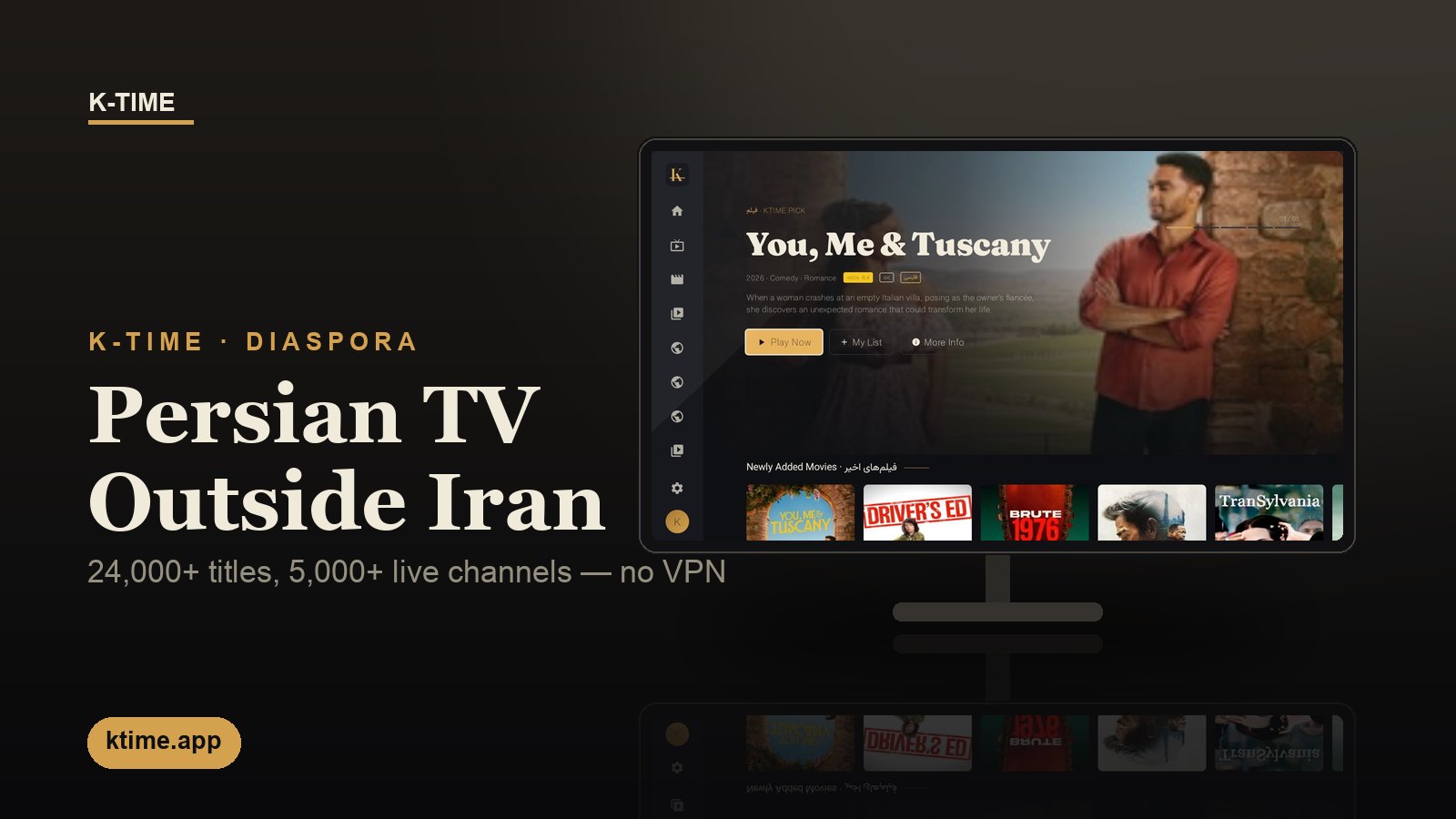
If you grew up in Tehran and now live in Toronto, Los Angeles, Stockholm or Hamburg, you know the loop. A relative finishes a new Iranian series, sends you a clip on WhatsApp, and the service that has it tells you you are in the wrong country. You install a VPN. You go looking for an Iranian bank card you do not have. You give up.
The way out is not a better workaround. It is a service licensed for viewers outside Iran in the first place — which is what removes both the geo-block and the Iranian card in one move. This guide covers what that gets you in 2026, on which device, at what price, and where it still falls short.
| Category | Count (as of 2 September 2026) |
|---|---|
| Total streamable titles | 24,000+ |
| Iranian films | 2,300+ |
| Iranian series | 450+ |
| International titles with a Persian dub or subtitle track | 13,300+ |
| Live TV channels | 5,000+ |
| Persian-language live channels | 300+ |
| Price | CA$9.99/month · CA$54.99/6 months · CA$99.99/year |
Why don’t Iran-based streaming services work outside Iran?
Services licensed to stream inside Iran do not work abroad for two structural reasons, and neither is a bug you can route around. The first is licensing: a Persian-language film is sold as separate rights packages — a global deal, an Iran-only deal, a diaspora deal — and a service that bought the Iran-only package is contractually bound to block foreign IP addresses at the application layer. The second is banking: their checkout runs on Shetab, the Iran-domestic interbank card network, which does not accept Visa, Mastercard or Amex. So even a subscriber who tunnels past the first wall stops dead at the second. A decade of VPN advice was always going to end there.
Do I need a VPN to watch Persian TV outside Iran?
Not on K-Time, and this is the single most useful thing to know. K-Time holds diaspora rights rather than Iran-domestic rights, so there is no region to spoof, no IP allowlist, and no “not available in your country” screen at the end of signup. Nothing depends on pretending to be somewhere you are not, and nothing breaks when a VPN provider rotates its server list mid-episode. The practical difference in a household is that a parent can turn the television on and start watching without anyone else being home to fix a tunnel first.
Can I pay with a foreign card?
Yes — K-Time’s checkout takes any ordinary Visa, Mastercard or Amex issued outside Iran. A Canadian, American, British, German, Swedish or Australian card all work the same way, with no Iranian bank account, no intermediary and no crypto step. Billing is set in Canadian dollars and your own bank converts at its rate on the day, so there is no separate USD or EUR plan to hunt for. The only audience that needs a different rail is buyers located inside Iran, who cannot reach the card processor at all; for them there is a USDT plan from 4 USDT a month or 36 USDT a year arranged through the Telegram bot @KtimeSaleBot, and no VPN is required for that either.
What does “works outside Iran” actually mean for a household?
In a house where one grandparent reads only Farsi and a teenager reads only English, “works” has to mean several things at once. It means no VPN, so anyone can start it. It means a foreign card at checkout. It means a library with both this month’s Iranian releases and the classics — not just A Separation and Children of Heaven, but Tasian, Vahshi, Shahrzad and last week’s arrival. It means a real app on the television, not a cast-from-phone routine. It means a Persian interface, or one plain enough that Persian is not required. And it means Persian subtitles or dubs on international content, so the whole room can watch one thing. K-Time was built against that list.
How many films, series and channels are actually there?
As of 2 September 2026 the catalog holds 24,000+ streamable titles, all served from local storage rather than a remote source, so what you see in a list is what will actually play. Of those, 2,300+ are Iranian films and 450+ are Iranian series with episode-level metadata. The largest block is the 13,300+ international films and series carrying a Persian dub or a Persian subtitle track — Turkish, Korean, European and American titles that a Persian-first household can watch together. On the live side there are 5,000+ channels, of which 300+ are Persian-language. Our Persian live TV guide goes through that grid channel by channel.
Which Iranian films and series can I watch?
The Iranian shelf runs from the canon to last month. Recent prestige cinema includes Baradaran Leila (Leila’s Brothers, 2022), Daneye Anjire Ma’abed (The Seed of the Sacred Fig, 2024, nominated for Best International Feature at the 97th Academy Awards) and the Palme d’Or-winning Yek Tasadof Sadeh (It Was Just an Accident). Home-video series — Tasian, Vahshi, Shoghal, Jeyran, Shahrzad — arrive season by season with Farsi metadata. If you want a starting point rather than a catalog, our roundup of the best Iranian series to binge in 2026 and the 2025 Iranian films collection are both built for the “what do we put on tonight” question.
What can I watch if half the family doesn’t read Farsi?
Two shelves solve most of that. The first is the Iranian films with English subtitles collection — a hand-checked set including A Hero, There Is No Evil, Certified Copy and In the Land of Brothers — which lets a second-generation viewer or a non-Persian-speaking partner watch the same film without anyone translating over the top. The second runs the other way: international series with a Persian subtitle or dub track, so the grandparents can follow what the kids picked. Turkish drama is the biggest single block there, with 316 of 384 Turkish series carrying Persian subtitles; the Turkish series with Persian subtitles guide maps that shelf.
Do I need a device at all, or can I watch in a browser?
You need nothing but a browser to start. K-Time streams films, series and live TV directly at ktime.app/app in Chrome, Safari, Edge or Firefox, on a phone, tablet, Mac, Windows PC or Chromebook, with nothing to install. iPhone and iPad are included — they play through Safari using native HLS. This is the fastest way to test the service tonight and decide whether the catalog suits your household before you touch any hardware. The browser walkthrough is the two-minute version. There is also a native Android phone and tablet app if you would rather open an app than a tab.
What is the best TV device for Persian TV?
For most households the answer is the television you already own. Any Sony, TCL, Hisense, Xiaomi, Philips or Sharp set sold in the last four years runs Google TV or Android TV, and the K-Time app installs from ktime.app/k in about three minutes via the Downloader app; after that the icon sits on the home screen and launches with one click. If your television is older, an Amazon Fire TV Stick 4K Max (around US$40) in a spare HDMI port turns it into the same thing, using the same three-minute install. For a household that wants the best 4K and HDR pipeline, the Nvidia Shield Pro (around US$200) is the premium pick and lasts years. Our device-by-device setup guide covers each one.
Does K-Time work on a Samsung, LG or Apple TV?
Yes, but not through a native app, and we would rather be plain about that than let you find out after paying. The K-Time TV app is Android-based, so Samsung Tizen, LG webOS and Apple TV have no native app, and there is no AirPlay. On a Samsung or LG you install the free Media Station X app from the television’s own store and type a personal {code}.ktime.app address once; from then on it opens straight into the branded K-Time portal with no login to type. On an Apple TV you watch in a browser on another device, or add a Fire TV Stick to the HDMI port. The screen-by-screen version lives in the all-device how-to-watch guide.
Is there a ready-made box for parents who won’t set anything up?
In the Greater Toronto Area, yes. A pre-configured K-Time دستگاه sits on shelves at Iranian grocery and electronics stores across the GTA — through Willowdale, Thornhill and Richmond Hill, and along Yonge in North York. You buy it like any television accessory, plug it into an HDMI port, turn it on and sign in. K-Time is already installed; nobody sideloads anything and nobody has to drive over to help. This is the path we point older parents to. It is a GTA arrangement only — it is not sold in the US or in Europe — and our walkthrough on setting up Persian TV for parents covers the one-time sign-in either way.
How much does it cost in US, Canadian, euro or pound terms?
K-Time costs CA$9.99 a month, with cheaper longer plans, billed in Canadian dollars and converted by your own bank. There is no separate USD or EUR plan.
| Plan | Price | Per month | Saves vs monthly |
|---|---|---|---|
| Monthly | CA$9.99 | CA$9.99 | — |
| 6-month | CA$54.99 | CA$9.17 | ~8% |
| Annual | CA$99.99 | CA$8.33 | ~17% |
At the 2 September 2026 rate, CA$9.99 was about US$7.20, €6.20 or £5.30, and the annual plan works out near US$6.00 a month. Rates move, so treat those as approximate; the Canadian figures are the fixed ones. Create an account and the first film is playing in about two minutes.
How many screens can watch at once?
One device at a time. Switching is free and instant — the television tonight, a phone on the train tomorrow, a laptop at a relative’s house next week — but two screens cannot play simultaneously on a single account. A two-generation household that genuinely watches in two homes at the same hour needs two subscriptions, and we would rather say that here than have someone discover it on a Friday evening.
Is the live news free anyway?
Some of it, and we will say so plainly. Several Persian news networks stream free on YouTube and on the broadcasters’ own websites, so if you only ever watch live news on a laptop you may not need a subscription at all. Where a paid catalog earns its CA$9.99 is elsewhere: recent Iranian films and series within weeks of release, at full quality, on the television, behind one account — plus those same news channels gathered onto one remote, which is what makes the difference for a parent who does not want to juggle four apps to find the evening bulletin.
What if I live in Germany, or my family speaks Dari?
Both have their own guide now, because the details differ. Germany is the largest Iranian community in Europe — roughly 319,000 people of Iranian background on the 2024 federal statistics, against about 126,700 in Sweden and 118,300 in France per the Iranian diaspora overview — and the Germany guide covers euro pricing, German cards, and which devices are easy to buy there. If Dari or Pashto is the language at your table, the Persian and Dari TV guide for Afghans in Europe lists the fifteen Afghan and Pashto-language channels in the live grid and explains what a Persian subtitle track opens up for a Dari reader. City editions exist too, for Toronto, Los Angeles and Vancouver.
The honest closing thought
The diaspora was told for two decades that the only way to watch what is happening at home was a VPN, a relative’s password or a sketchy aggregator. That was true once. It is not any more, and the reason is unglamorous: the rights were bought for the audience that lives here.
What we ask in return is that you treat the people who make these films like the people they are. The directors, the actors, the crews — most of them work for what they earn, and a CA$9.99 subscription is part of how the next film gets made. If K-Time fits your household, signup is here; browse every film and series or the rest of the journal first if you would rather look before you decide. The Farsi edition of this guide covers the same ground for Persian-script readers.