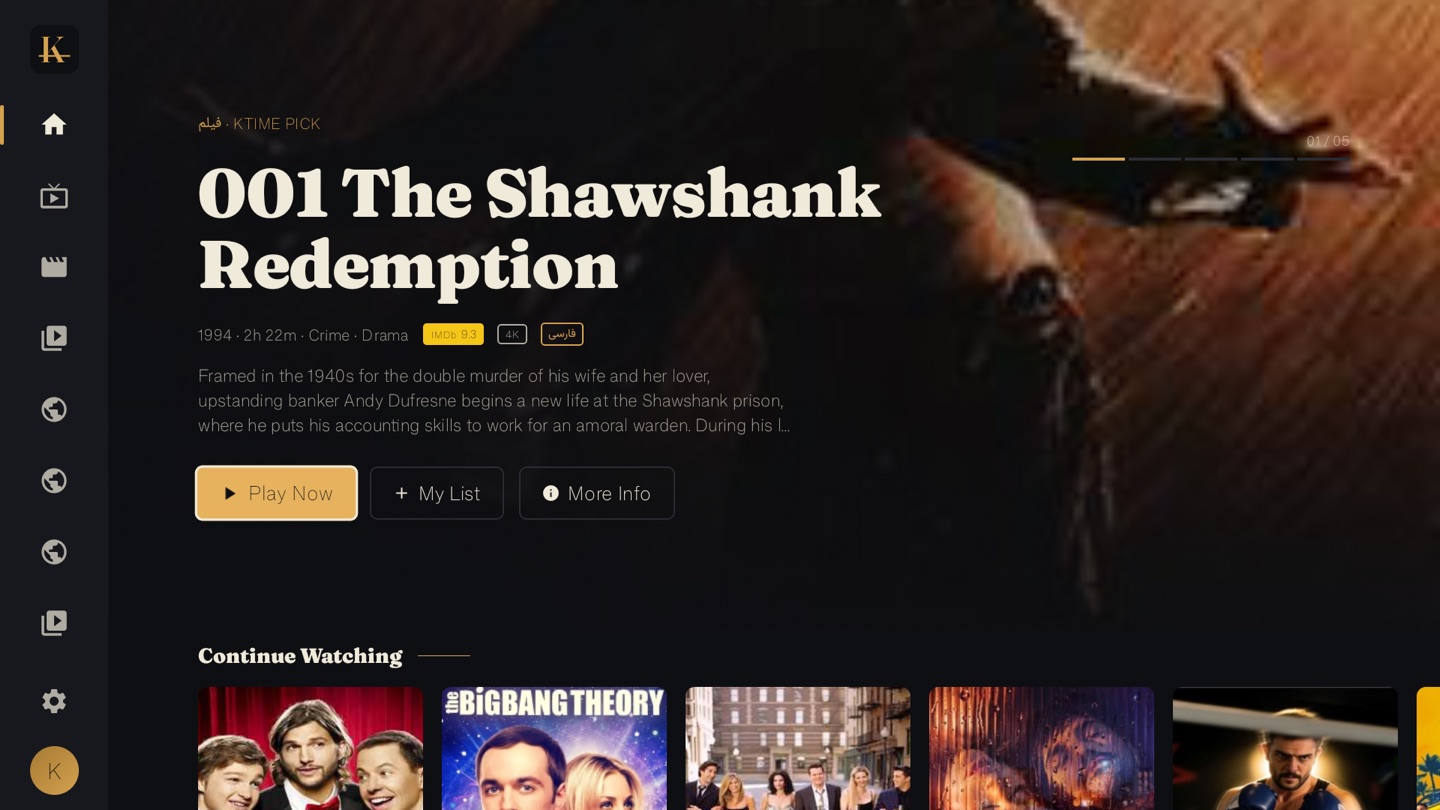
If you live in Westwood, Encino, Tarzana or anywhere across greater Los Angeles, the way you watch Persian television changed when the satellite dish stopped being the answer. For two generations, Tehrangeles meant LA-produced Persian channels beamed in over a dish on the roof. In 2026 that signal lives on the internet, and you reach it with a streaming app on the TV — the same hardware you already use for Netflix.
This guide is for Iranian families in Los Angeles who want Persian live TV and Iranian film on the living-room screen, legally, without a VPN, and paid with a US card. We cover what replaced the dish, which channels you actually get, and how to set it up in a household where one grandparent only reads Farsi.
| Iranian community in greater LA | ~500,000–600,000 (largest outside Iran) |
| What you need | A web browser, or an Android TV / Google TV / Fire TV / Nvidia Shield — and a K-Time account |
| Monthly cost | About US$7 (CA$9.99/mo, CA$99.99/yr) — US cards work, no VPN |
| Setup time | About 3 minutes to sideload via Downloader |
Why is Los Angeles called Tehrangeles, and how big is the community?
Los Angeles holds the largest Iranian community anywhere outside Iran — an estimated 500,000 to 600,000 Iranian-Americans across the greater metro, enough that the area earned the name Tehrangeles. The community took root in Westwood after 1979 and spread out to Tarzana, Encino, Woodland Hills, Beverly Hills, and south into Irvine and Orange County, as documented in the history of Iranian-Americans in Los Angeles.
That presence is marked on the city itself: the intersection of Westwood Boulevard and Wilkins Avenue is officially recognized by the City of Los Angeles as Persian Square. A market this size is why so much diaspora Persian television was produced here in the first place — and why streaming had to catch up to it.
Whatever happened to LA’s Persian satellite channels?
The “LA TV” era — a generation of Persian channels broadcasting out of Los Angeles over satellite — is effectively finished, and that is the single biggest change to how you watch Persian TV in the city. Through the 1990s and 2000s, an LA household with a dish on the roof pulled in dozens of Persian-language channels produced a few miles away in the Valley. The receiver box, the dish alignment, the monthly satellite bill: that was the cost of staying connected.
Satellite did not die because the audience left. It died because the internet does the same job for less. The channels that mattered most — Manoto, GEM TV, PMC, and the news networks — now stream over IP, so a single app on the TV replaces the dish, the box and the bill. If your parents still have a dish bolted to a Tarzana balcony, it is doing a job a US$7 subscription now does better.
Which Persian channels can I watch in LA, and what about film?
In Los Angeles you can stream 300+ Persian live channels on K-Time, including Iran International, BBC Persian, Manoto, GEM TV and PMC, drawn from a wider set of 5,000+ live channels worldwide. That covers the news networks the diaspora actually keeps on in the kitchen, the entertainment channels Tehrangeles built, and the music and general-interest channels in between.
Live TV is half of it. As of June 2026 the K-Time catalog also carries:
| Category | Count |
|---|---|
| Iranian films | 2,300+ |
| Iranian series | 450+ |
| Persian-dubbed international titles | 7,200+ |
| Persian live channels | 300+ (of 5,000+ total) |
Those Iranian films run from the classics to recent prestige cinema — including Mohammad Rasoulof’s banned 2024 drama The Seed of the Sacred Fig (Dāne-ye Anjīr-e Ma’ābed). For what is worth a Tuesday evening, the best Iranian thrillers to stream hold up on a big LA living-room TV, and the best Iranian films of 2025 hub is the newest slate, ordered newest-first.
Why can’t I just use Filimo or Namava from California?
You cannot use Filimo or Namava in California because both license their catalogs for inside Iran only, and both require an Iran-issued Shetab bank card to subscribe. Their apps block US IP addresses at the application layer, and even if you mask your location with a VPN, the payment step fails without an Iranian account. These are licensing and banking constraints, not bugs you can configure around — the same wall the rest of the diaspora hits, covered in depth in our guide on watching Persian TV outside Iran.
K-Time exists in the gap that leaves. There is no geo-block anywhere in the US, the signup portal takes US Visa, Mastercard and Amex, and no VPN is involved at any step.
What does it cost, and does my US card work?
K-Time costs about US$7 a month, and yes, your US card works. The plans are billed in Canadian dollars and convert at your bank’s rate:
| Plan | Price (CAD) | About (USD) |
|---|---|---|
| Monthly | CA$9.99 | ~US$7.30 |
| 6 months | CA$54.99 | ~US$40 |
| Annual | CA$99.99 | ~US$73 |
The annual plan works out to roughly US$7 a month. One subscription streams on one screen at a time, and moving between devices costs nothing — sign in wherever you are watching and the oldest session simply ends. You can watch right in the browser at ktime.app/app — on a phone, tablet or computer — or install the app on the TV for the living-room screen.
How do I set it up in a Los Angeles household?
The quickest setup in Los Angeles is no setup at all: open ktime.app/app in any browser and start watching — movies, series and live TV on a phone, tablet, laptop or iPad (iPhone and iPad play through Safari). For the living-room screen, you sideload the TV app onto an Android-based TV device with the Downloader app — about three minutes, start to finish. The TV app runs on Android TV, Google TV, Amazon Fire TV (Stick, Cube, 4K Max), Nvidia Shield, or a Chromecast with Google TV, and there’s a native Android phone and tablet app too. There’s no native iPhone or Apple TV app and no AirPlay — on those, you watch in the browser.
The steps:
- On the TV device, install the free Downloader app from its app store.
- Open Downloader and type
ktime.app/k. - Install the APK it serves you, then sign in with your subscription account.
If your only screen is a Samsung or LG smart TV, the cheapest fix is a ~US$40 Fire TV Stick in its HDMI port. For a household where nobody wants to touch a sideload — older parents whose only requirement is “open Persian movies without anyone helping me” — there is a pre-configured K-Time دستگاه sold at Iranian stores, though for now that retail program is in the Greater Toronto Area only. In LA, the Downloader route at ktime.app/k is the path, and a tech-savvy family member only has to do it once. Our walkthrough on setting up Persian TV for parents covers the one-remote handoff.
The honest closing thought
Tehrangeles built a television industry on satellite dishes when that was the only way to get Persian programming onto an LA screen. That era earned its place, and then the technology moved on — the same channels, the same films, now arriving over the connection that already runs the house. No dish, no VPN, no relative’s password.
If K-Time fits your household, the signup is here and the TV install page is at ktime.app/k. For Persian-script readers, the Farsi edition of this Los Angeles guide covers the same ground natively.